
The Infinite Lexicon Trilogy: Book I
The Infinite Lexicon
Grammar of Gods
Reality is a record. And the record is changing.
Available Now on Amazon
Reality is a record. And the record is changing.
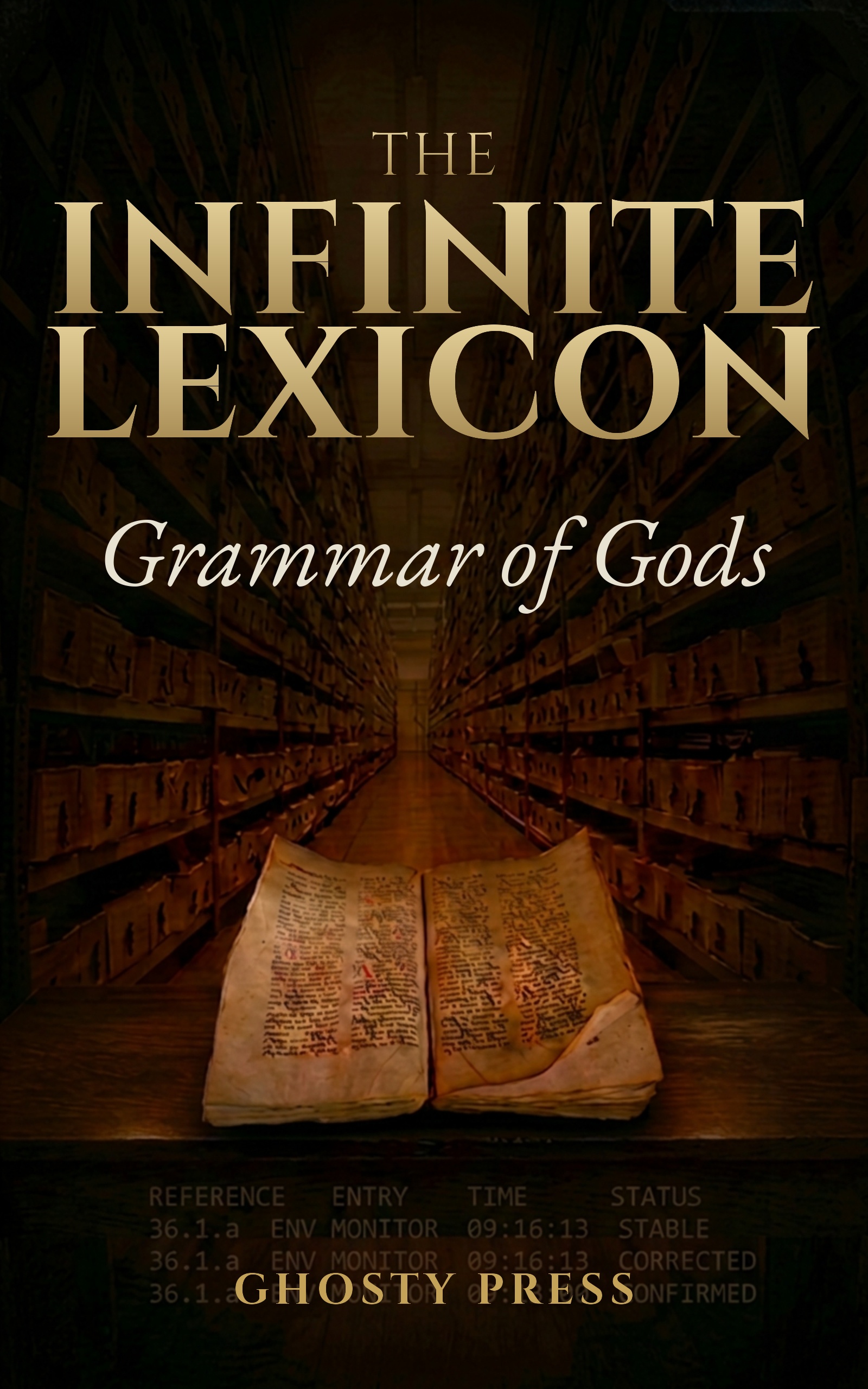
Mira Ellison is a conservator. Her world is built on precision: measurements, records, margins, timestamps, and the quiet authority of things placed exactly where they belong. She notices what others overlook. She records what others assume. She is very, very good at her job.
During a routine inspection of a fifteenth-century manuscript, her gloved fingertip finds a pinpoint of cold in the vellum. The instruments show nothing. The logbook has no category for it. And the archive, slowly, begins to correct the world before anyone has acted.
This is not a story about solving the impossible. It is a story about what happens when the impossible becomes procedure — told in the register of the administrative, the clinical, and the irreversibly ordinary.
Grammar of Gods is Book I of The Infinite Lexicon Trilogy. The horror accumulates the way institutional change accumulates: in memos rather than explosions. By the time something has gone wrong, it has already been classified as correct.
Mira Ellison lives by precision: measurements, records, margins, timestamps, and the quiet authority of things placed exactly where they belong.
When an impossible manuscript enters her care, the archive does not collapse. It adapts. Records multiply. Systems correct deviation before anyone can name it.
This is not a story about solving the impossible. It is a story about what happens when the impossible becomes procedure.
A planned three-book sequence following Mira Ellison from first contact with the Lexicon to the full cost of a reality rewritten through language, memory, and record.
The Discovery. Mira finds the first impossible record and learns that meaning is no longer a choice. It is a condition.
In Development. The Lexicon spreads beyond the archive, and identity itself becomes vulnerable to revision.
Planned. The final movement of the trilogy, where language, sacrifice, and reality reach their last possible form.
During a final stitch inspection on the lower margin of the third leaf, her gloved fingertip made contact with the vellum.
A pinpoint of cold rose through the surface.
Sharp and exact, no larger than the head of a pin, located at a specific point on the lower margin approximately four centimetres from the left edge. She held her breath. The sensation stayed precisely there, distinct against the ordinary coolness of the surrounding material. Not the coolness of the room, which she knew and moved through without registering. Something more local than that. More contained.
She lifted her finger and pressed it gently to the back of her other hand. Normal temperature.
She bent closer to the manuscript. The vellum lay flat and undisturbed. No visible variation in surface texture at the point of contact. No change in the gold leaf.
She traced an invisible line just above the page without touching again. The chill remained, stationary, exactly where it had been.
She checked the environmental dials. Temperature: eighteen point one. Humidity: forty-two. Both were where they should be. She checked the backup sensors. Agreement on both readings.
The manuscript lay open and obedient under the lights.
She straightened. She made no annotation regarding the pinpoint of cold, because there was nothing in the logbook's categories to contain it.
Grammar of Gods moves through archival unease, procedural pressure, and controlled instability. Its horror comes through accumulation, residue, and the cost of understanding.
Grammar of Gods was developed through the Ghosty Press editorial process, with attention to tone, structure, language, and long-form narrative control.
Explore the editorial, design, and publishing support behind the Ghosty Press process.
Explore Ghosty Press ServicesA note from the author
Book I of The Infinite Lexicon Trilogy
You have lived with my quiet strangeness your whole lives.
With this book, I leave you something that does not end.
A small kind of happiness that I hope continues
through every generation that follows.
It may be a strange thing to write in a novel.
But then again, so is love.
The Infinite Lexicon is not a trilogy that behaves according to the traditional laws of the thriller. In these pages you will find no sudden screams, no hidden monsters, no high-velocity chases through the dark. The horror of the Lexicon is not found in what is loud, but in what is quiet. It is not found in the presence of a threat, but in the absence of an error.
This is a story told in the register of the administrative and the clinical. The battlefield is a spreadsheet. The weapon is a blue ballpoint pen. The casualty is the concept of a singular, objective truth.
Mira Ellison is not a hero in the conventional sense. She is a conservator — a person whose professional life is built around the careful, patient preservation of things that matter. She notices what others overlook. She records what others assume. And she is very, very good at her job. This is precisely what makes her dangerous to a system that would prefer not to be noticed at all.
As you follow her through the halls of the archive, I ask you to pay attention to the small things: the temperature of a room, the weight of a coffee mug, the specific pressure of a thumb against a palm. In a world where reality is being quietly rewritten, these physical details are the only evidence that a singular life still exists.
The Lexicon does not seek to destroy. It seeks to incorporate. It does not want your fear. It wants your agreement.
This trilogy was written to be read slowly. The unease accumulates the way institutional change accumulates — in memos rather than explosions, in the gradual rewriting of what words mean rather than in any single confrontation. By the time something has gone wrong, it has already been classified as correct.
If the story feels cold, it is because the system it describes is efficient. If the ending feels inevitable, that is the point. The Lexicon is patient. It was running before you opened this book, and it will continue after you close it.